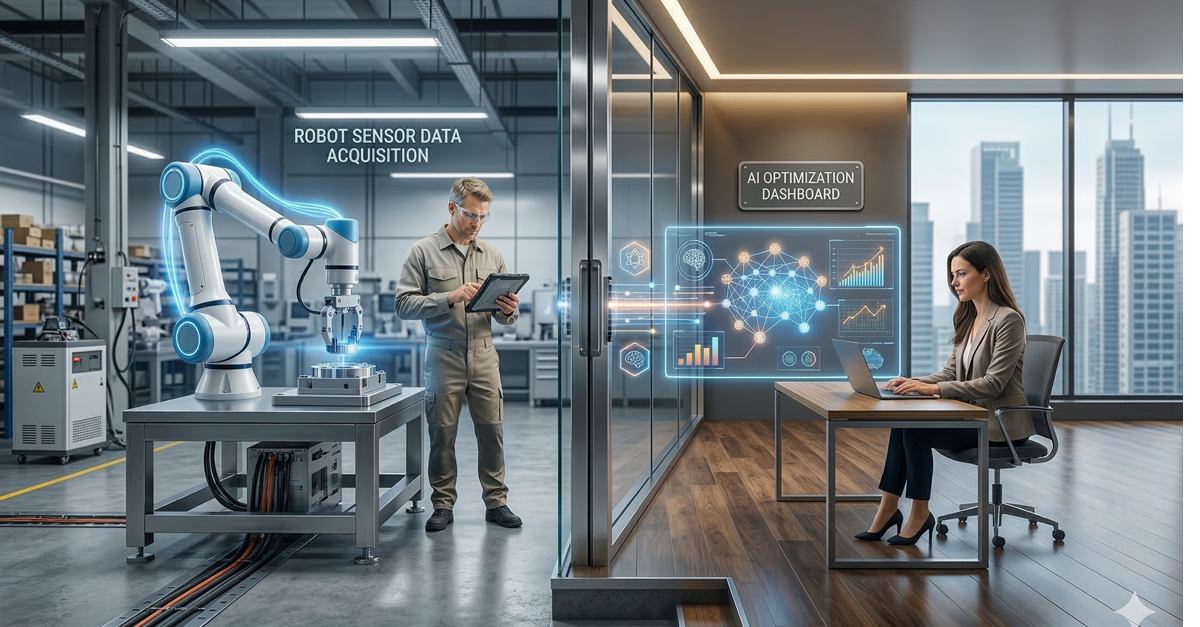
Will artificial intelligence augment office work similarly to the way co-bots augment manufacturing? (Gemini-generated image)
These days, one of the most commonly asked questions in the business world is, “Will my job be replaced by artificial intelligence?” But that might be the wrong question. A more appropriate one might be, “How will AI change the way I work?” I recently read an article that has begun to reframe the issue for me along those lines.
In “AI, Transaction Costs, and a Quiet Shift Toward Self‑Employment,” Liya Palagashvili, a labor economist at the Mercatus Center at George Mason University, indicates that the impact of AI on work, and workers, might not be what many expect. Palagashvili’s research indicates that AI has the potential to act as a powerful productivity force multiplier for individual workers, reducing the need for teams and supervisors to delegate tasks to them.
How AI Slashes ‘Transaction Costs’
Palagashvili hypothesizes that the catalyst behind this potential “elimination of the middleman” is AI’s potential to slash “transaction costs,” i.e., the costs of allocating labor to work tasks. In a scenario that’s familiar to many, the transaction costs of completing a task internally is prohibitive for one firm, so it outsources the work to another one that specializes in the work. The latter firm has managers in place to allocate tasks to specialists.
Based on several advantages, AI can give individual workers on the open market the edge over firms, which rely on teams and managers to get work done, Palagashvili argues. For one thing, AI can make collaborative work more separable and measurable, which favors individual workers.
Furthermore, AI can enable individual workers to complete multiple specialized tasks, reducing the need for the division of labor. It can reduce workers’ reliance on proprietary work tools that firms own. Last but not least, AI can further reduce “search-and-specification” costs.
For many, a familiar example of inexpensive search and specification is how Uber instantly matches those who need to get somewhere with drivers using the wonders of digital technology. Easier search and specification might also enable individual workers to offer their services on the open market in real time, not unlike the Uber transaction model, Palagashvili argues.
Co-Botics Transforms Line Workers into Managers
Recently, all of the talk about generative, agentic, or other future iterations of AI wiping out millions of jobs got me thinking that its true impact will be to augment human work. I think the scenario Palagashvili presents has parallels to semi-automation in manufacturing.
For a long time, many thought robotics, too, would eliminate many manufacturing jobs. As it’s turning out, however, the reality might be a bit more nuanced.
Several years ago, I wrote a blog post titled, “Robots or ‘Co-Bots’ Are Coexisting with Humans in Manufacturing Environments” for AGI Automation Components, a manufacturer of pneumatic industrial automation products. I’ve left a link to the post below for your reading pleasure, but the point is that manufacturing industry automation is more about utilizing ‘co-bots,’ i.e., robots designed to share tasks with human manufacturing workers rather than replace them.
The trick with incorporating co-bots into manufacturing workflows for maximum productivity is assigning respective tasks that humans and robots are best suited for.
The thinking goes like this: Repetitive manufacturing tasks requiring lots of physical, repetitive movement can be delegated to co-bots, freeing up human workers to apply more strategic critical thinking to their jobs, effectively transforming them into managers who monitor and fine-tune processes rather than actually perform them.
Growth of Co-Botics: A Preview of AI in Office Work?
The use of co-botics has been growing since I wrote that post:
The global collaborative robot market is expected to grow from $894.60 million in 2021 to $7 billion by 2030, according to real-time AI robotics intelligence provider Inbolt.
According to a 2024 Global Growth Insights report, more than 62% of manufacturers have begun to use co-bots for multi-task operations and nearly 48% deploy them to boost assembly-line efficiency.
Technology research firm Interact Analysis reported that, despite a recent dip, global co-bot shipments still grew by 13.8% in 2024.
Will the incorporation of AI into office jobs reach a similar penetration level in a few years? AI has the potential to free white-collar workers from indexing ‘Big Data’ in a fraction of the time so they can focus on managing the project that contains the Big Data. In this scenario, AI and human office workers team up on projects much like co-bots and manufacturing workers team up on an assembly line.
Is a Shift to Entrepreneurship Already Under Way?
To me, a massive workforce shift to self-employment would accelerate a trend that has emerged in many information-based professions over the past couple of decades, including mine — communications/marketing. Among other sea changes it has caused, digitization has enabled marketing teams to complete more projects faster. In fact, work in my profession and many others, such as IT, has become increasingly project-based.
That’s why I have begun to question the usefulness of full-time marketing teams from employers’ perspective, given how project-oriented marketing work has become. For example, I know several peers who are ‘fractional,’ i.e., part-time CMOs (chief marketing officers). Also, perhaps the increasingly project-oriented nature of marketing is also a big reason why most of the marketers I know have made several career stops over the past 10–15 years.
Implication: Social Insurance Challenges
A massive shift to self-employment presents a host of public policy challenges relating to social insurance, Palagashvili points out. The social insurance system — including health insurance, for example — is based on W2 work for a single employer and measurable work hours.
If more people are working for multiple firms, concepts such as employer-sponsored health insurance coverage and minimum wage, as we know them, might become unwieldy, even unrealistic. I wonder what would replace them. What public policy solutions would emerge in response and when, in such a politically divided nation?
For example, it’s hard to envision Congress passing bipartisan legislation to address the high costs of coverage under the Affordable Care Act anytime soon. Both parties dug in over the expiration of COVID-era subsidies during — what was it — the current government shutdown, or was it the last one? I guess I’ve lost track. For now, it feels like ACA coverage carries higher out-of-pocket costs and is decidedly inferior to employer-sponsored coverage in most cases, although I’ll admit I don’t have hard numbers to back up that assertion.
Similarly, we often hear that many Baby Boomers have little or no retirement savings and that the U.S. Social Security system faces a long-term funding shortfall. If more workers become entrepreneurs, more will be responsible for saving for their retirement — fewer will have access to employer-sponsored 401(k) plans with automatic payroll deductions.
Many already believe that the typical worker has not benefited from companies’ shift from pensions to such defined-contribution plans as it is. That sentiment might increase if entrepreneurship becomes more common.
Again, given Social Security funding challenges and potentially less participation in employer-sponsored defined-contribution plans that many consider inadequate to begin with, what are the public policy implications? When might a U.S. Congress that has collectively feared touching the ‘Third Rail of Politics’ for decades act to facilitate greater retirement security for U.S. workers?
Another Catalyst for Non-Linear Careers?
Ultimately, AI might be another in a series of catalysts making non-linear careers the rule rather than the exception over the past few decades. That seems plausible.
References
Liya Palagashvili, Labor Market Matters, “AI, Transaction Costs, and a Quiet Shift Toward Self‑Employment”: https://www.labormarketmatters.com/p/ai-transaction-costs-and-a-quiet
AGI Automation Components blog, “Robots or ‘Co-Bots’ Are Coexisting with Humans in Manufacturing Environments”: https://www.agi-automation.com/robots-or-co-bots-are-coexisting-with-humans-in-manufacturing-environments/
Inbolt blog, “Cobots in Manufacturing”: https://www.inbolt.com/resources/blog/cobots-in-manufacturing/
Global Growth Insights, “Collaborative Robot Market Size, Share, Growth, and Industry Analysis, by Types (Power and Force Limiting, Safety Monitored Stop, Speed and Separation, Hand Guiding), by Applications Covered (Packaging, Assembling, Material Handling, Machine Tending, Quality Testing, Others), Regional Insights and Forecast to 2035”: https://www.globalgrowthinsights.com/market-reports/collaborative-robot-market-100597
Interact Analysis, “Collaborative Robots’ Revival Forecast from 2025, as Market Shifts Post-Trough”: https://interactanalysis.com/insight/collaborative-robots-revival-forecast/